Does Generative AI Narrow Education-Based Productivity Gaps? Evidence from a Randomized Experiment
NBER's Does Generative AI Narrow Education-Based Productivity Gaps? (February 2026; n=1,174 adults, randomized experiment) found that access to a GPT-4.1 assistant closed three-quarters of the performance gap between higher- and lower-education participants on a business task.
0.548 SD
0.139 SD
Key findings
- 01AI access raised task scores by 1.242 standard deviations for lower-education participants and 0.834 for higher-education participants.The assistant was built on OpenAI's GPT-4.1 and embedded in the task interface. (p. 2)
- 02Without AI, higher-education participants outscored lower-education ones by 0.548 SD; with AI, the gap fell to 0.139 SD, closing 75% of it.A remaining gap reflects that higher-education users prompted in more structured ways. (p. 2)
- 03AI cut completion time by 1.514 minutes for higher-education participants against a 10.423-minute control average, and by 0.961 minutes for lower-education participants against 10.697.The difference in time effects between groups was not statistically significant. (p. 15)
- 04In a follow-up without AI, lower-education participants who had used AI scored 0.171 SD higher than controls.The effect for higher-education participants (0.071 SD) was not statistically significant; there was no evidence prior AI use hurt later performance. (p. 16)
- 05About 13% of control-group participants appear to have used AI anyway.That implies a 70–71 percentage-point difference in AI use between treatment and control groups. (p. 11)
By the numbers
1.242 SDscore gain from AI, lower-education group
0.834 SDscore gain from AI, higher-education group
0.548 → 0.139 SDeducation gap without vs. with AI
What it means for you Draft
For executives at $10–100M companies
In this controlled test, an AI assistant helped less-credentialed workers most, narrowing the gap with degree holders on a general business task. For a $10–100M company competing for talent, it hints that AI may widen the pool of people who can do some knowledge work, though skill differences did not disappear. It is a lab-style task, so treat it as a signal rather than proof for your roles.
For practitioners
Structured prompting still separated stronger from weaker results, so short training on how to brief an AI assistant may pay off. Lower-education participants also kept some gains after the AI was removed.
Limitations
High trust.Preregistered randomized experiment (AEA-RCT 0016607) with full paper; academic authors; no AI vendor funding disclosed.
An online experiment outside firms, on a short (about 20-minute) general business task, in Argentina; real jobs involve context and accountability the task lacked. NBER working papers are not peer-reviewed.
National Bureau of Economic Research. "Does Generative AI Narrow Education-Based Productivity Gaps? Evidence from a Randomized Experiment." February 2026. https://www.nber.org/papers/w34851
Related reports
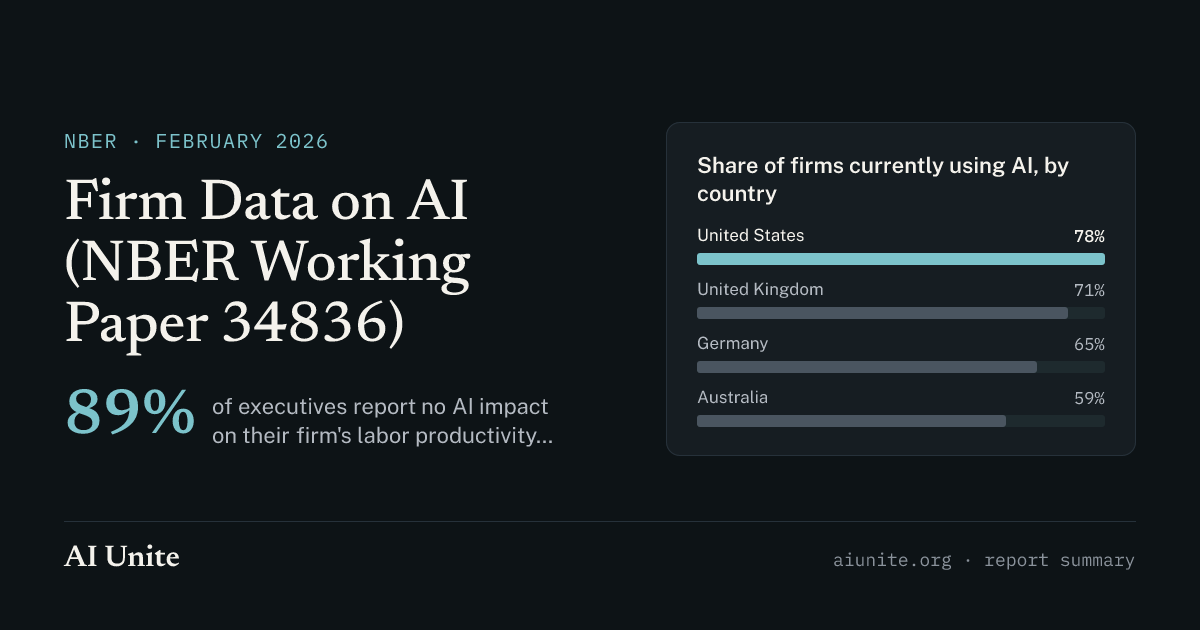 Firm Data on AI (NBER Working Paper 34836)Across four countries, most firms use AI, but nine in ten executives report no effect yet on jobs or productivity at their own firm.
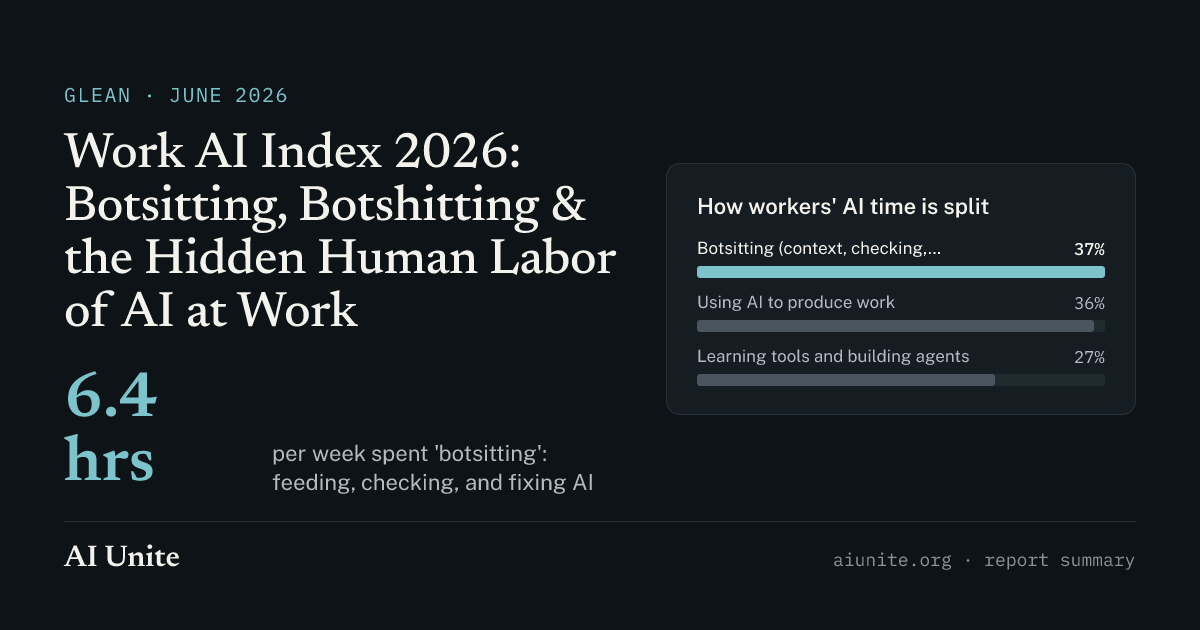 Work AI Index 2026: Botsitting, Botshitting & the Hidden Human Labor of AI at WorkWorkers report 11 hours a week saved but 6.4 hours spent supervising and fixing AI; only 13% see significant organizational gains.
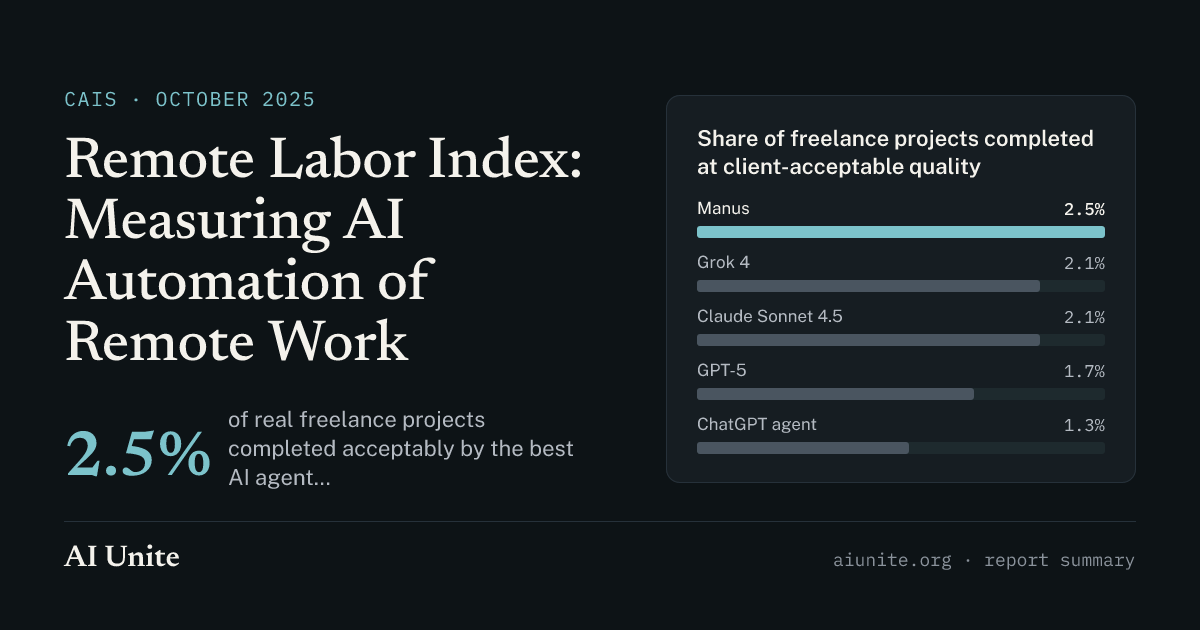 Remote Labor Index: Measuring AI Automation of Remote WorkOn 240 paid freelance projects worth over $140,000, the best agent tested produced client-acceptable work 2.5% of the time.