Firm Data on AI (NBER Working Paper 34836)
NBER's Firm Data on AI (February 2026, revised March 2026; nearly 6,000 executives in the U.S., UK, Germany and Australia, executive survey) found that 69% of firms use AI but more than 90% report no impact on their employment and 89% no impact on productivity over the past three years.
78%
71%
65%
59%
Key findings
- 0169% of firms across the four countries actively use AI, from 78% in the U.S. to 59% in Australia.The most common use is text generation with large language models, cited by 41% of firms. (p. 10)
- 02More than 90% of executives report no impact of AI on own-firm employment over the past three years.The share reporting no impact ranges from 95% in Germany to 81% in Australia. (p. 13)
- 0389% report no impact on labor productivity, measured as sales per employee, over the past three years.Converted to an average, the reported past productivity effect is about 0.29%. (p. 15)
- 04Executives expect AI to raise productivity 1.4% and cut employment 0.7% at their firms over the next three years.U.S. executives expect the largest productivity gain, 2.3%; the paper equates the employment effect to about 1.75 million fewer jobs across the four countries by 2028. (p. 3–4, 16)
- 05More than two-thirds of executives use AI themselves, averaging 1.5 hours a week.U.S. employees surveyed expect AI to raise employment at their firms by about 0.5%, the opposite direction from executives. (p. 3, 18)
By the numbers
69%of firms actively use AI
90%+report no AI effect on employment so far
+1.4%expected productivity effect over next 3 years
What it means for you Draft
For executives at $10–100M companies
This is one of the most careful large surveys of executives so far, run through central banks, and it finds that most firms using AI have not yet seen measurable changes in headcount or output per worker. For a $10–100M company, that suggests peers are not pulling ahead as fast as headlines imply, and there is time to be deliberate. Executives do expect gains in the next three years, but these are forecasts, not results.
For practitioners
When reporting AI results internally, measure sales or output per employee rather than usage, since this study shows usage and measured impact can diverge widely. Executives and employees disagree about the job effects, so be open about plans to reduce anxiety.
Limitations
High trust.Large, representative central-bank panels with verified, unpaid respondents; methods fully disclosed; authors do not sell AI.
Past and expected effects are executives' own estimates, converted to percentages using category midpoints, not measured outcomes. It is a working paper, not yet peer reviewed, and new firms that AI might create fall outside the sample.
National Bureau of Economic Research. "Firm Data on AI (NBER Working Paper 34836)." February 2026. https://www.nber.org/papers/w34836
Related reports
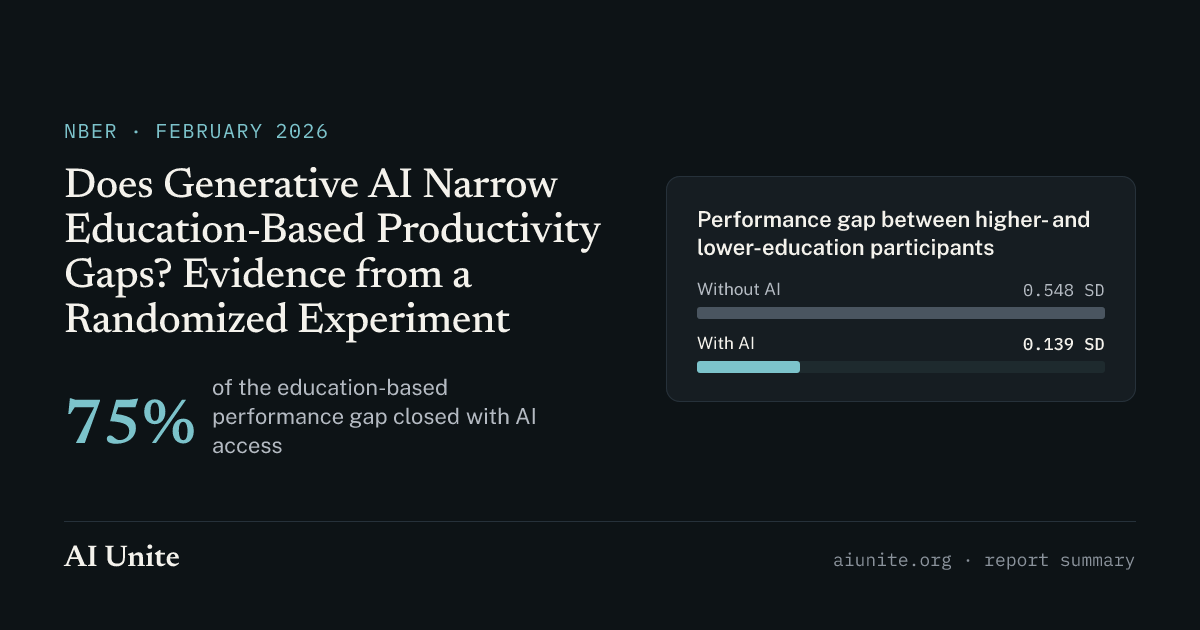 Does Generative AI Narrow Education-Based Productivity Gaps? Evidence from a Randomized ExperimentIn a randomized test, an AI assistant lifted everyone's scores and cut the gap between higher- and lower-education workers by 75%.
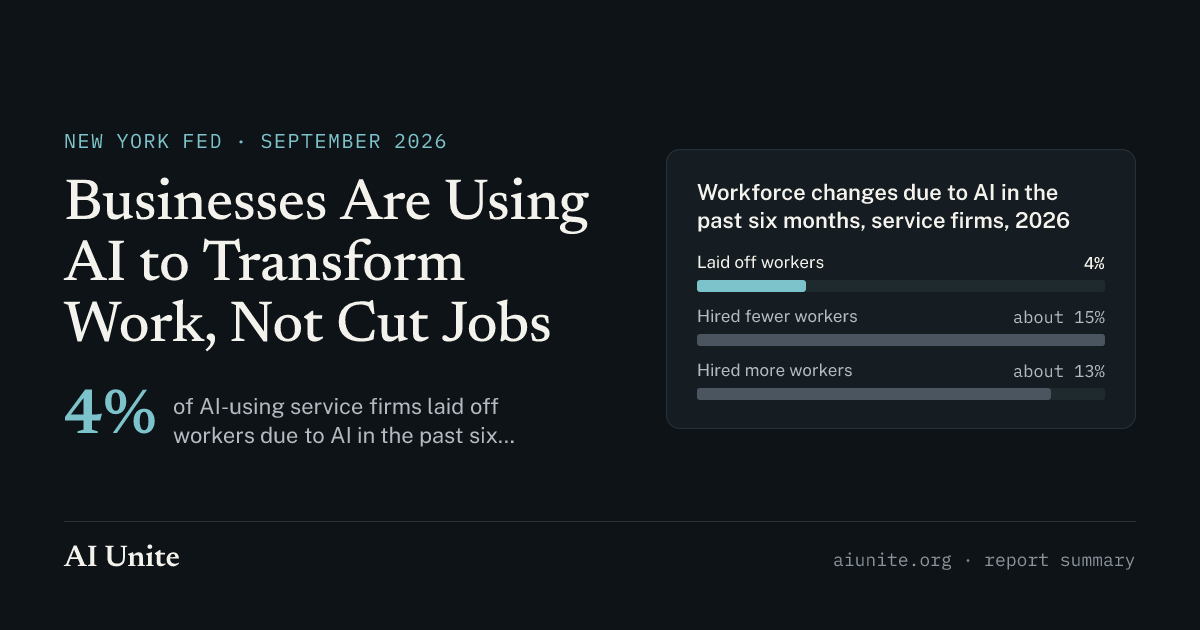 Businesses Are Using AI to Transform Work, Not Cut JobsAI use among regional firms jumped again in 2026, but layoffs stayed rare; retraining remains the main workforce response.
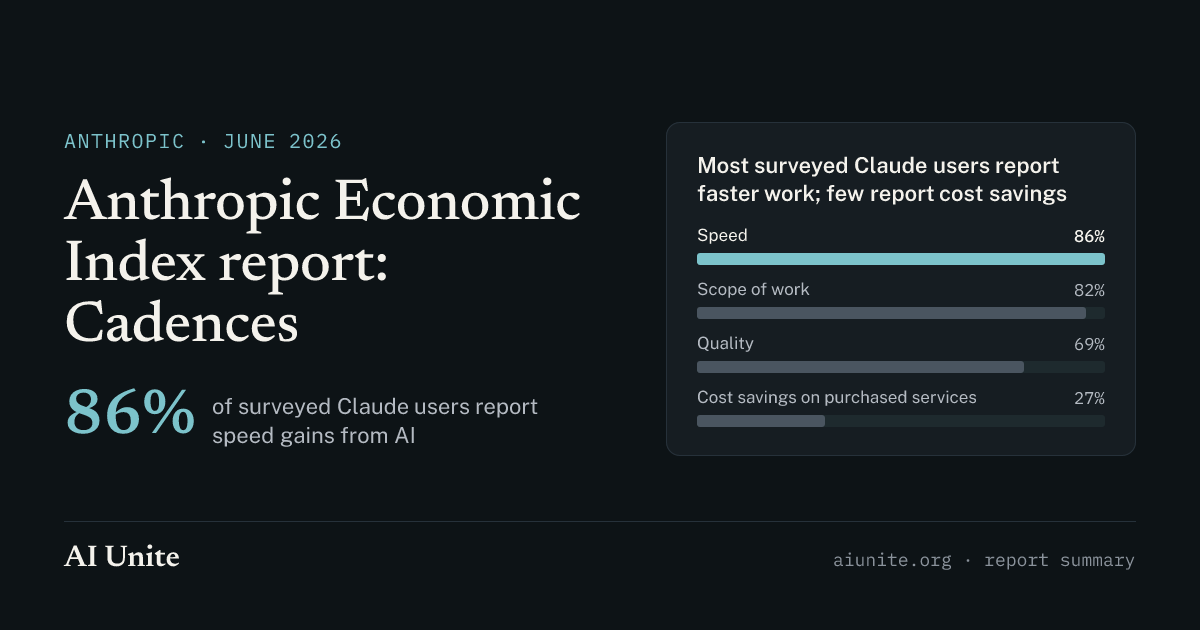 Anthropic Economic Index report: CadencesOver one-third of respondents expect AI to handle most or nearly all of their work tasks within 12 months.