The AI Productivity Paradox Report 2025
Faros AI's The AI Productivity Paradox Report 2025 (July 2025; n=10,000+ developers across 1,255 teams, telemetry analysis) found that developers on high-AI-adoption teams merged 98% more pull requests, but review time rose 91% and company-level delivery showed no measurable improvement.
Key findings
- 01Developers on teams with high AI adoption completed 21% more tasks and merged 98% more pull requests.These are correlations between team AI usage and output metrics, standardized within each company.
- 02Pull request review time increased 91% on those teams.Faros describes human review as the bottleneck that absorbs individual gains.
- 03AI adoption was associated with a 9% increase in bugs per developer and a 154% increase in average PR size.Larger, more numerous changes put more load on review and testing.
- 04Developers on high-adoption teams touched 9% more tasks and 47% more pull requests per day.More parallel workstreams per person; Faros frames this as a shift in how context switching should be read.
- 05There was no significant correlation between AI adoption and company-level improvement in throughput, DORA metrics, or quality.Team-level gains did not show up when aggregated to the organization.
By the numbers
21%more tasks completed (high-AI teams)
91%increase in PR review time
9%increase in bugs per developer
What it means for you Draft
For executives at $10–100M companies
More code and more tasks per developer did not turn into faster delivery at the company level in this data. For a $10–100M company with a small engineering team, the likely lesson is that review, testing, and release capacity need attention at the same time as coding tools, or the gains pile up in a queue.
For practitioners
Track review time, PR size, and bug rates alongside output when you roll out coding assistants. Smaller PRs and faster review paths may matter as much as the assistant itself.
Limitations
Medium trust.Large telemetry sample with stated statistical method, but correlational, customer-only data from a vendor selling AI-impact analytics.
Correlational telemetry from Faros customers, not a controlled experiment; teams that adopt AI heavily may differ in other ways. The full report is gated, and customer mix and company sizes are not described on the public page.
About the publisher: Sells engineering analytics software, including tools that measure AI coding-assistant impact; data comes from its customers.
Faros AI. "The AI Productivity Paradox Report 2025." July 23, 2025. https://www.faros.ai/blog/ai-software-engineering
Related reports
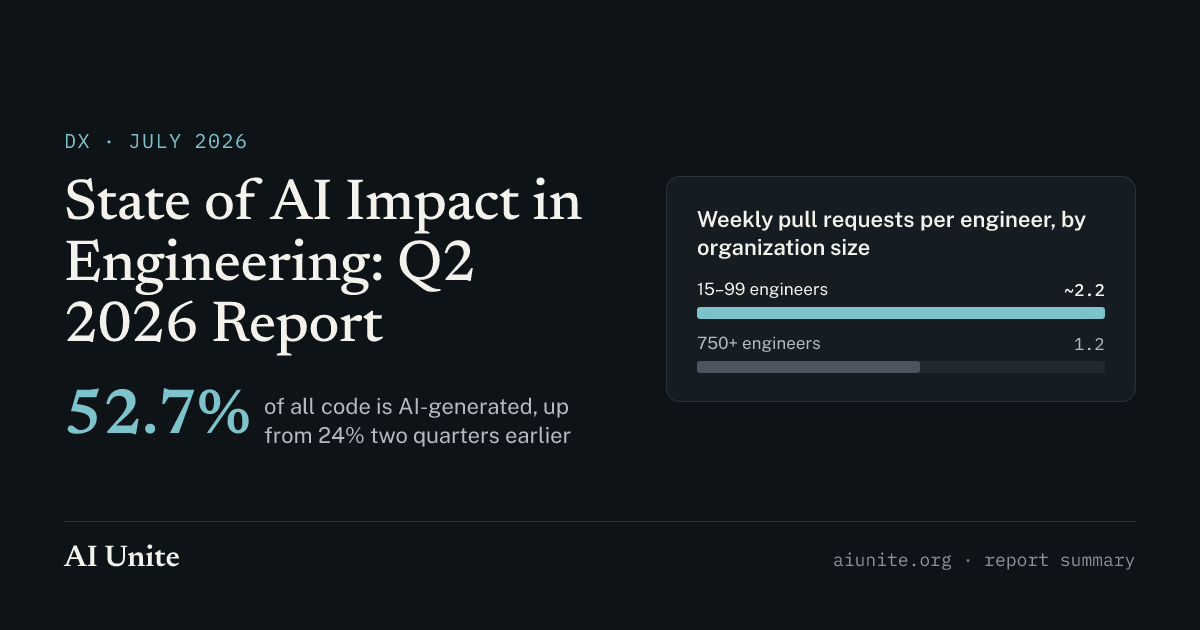 State of AI Impact in Engineering: Q2 2026 ReportAI now writes 52.7% of code and AI spend rose ~28x in tech, but time on new features stayed flat and change confidence fell 6.1%.
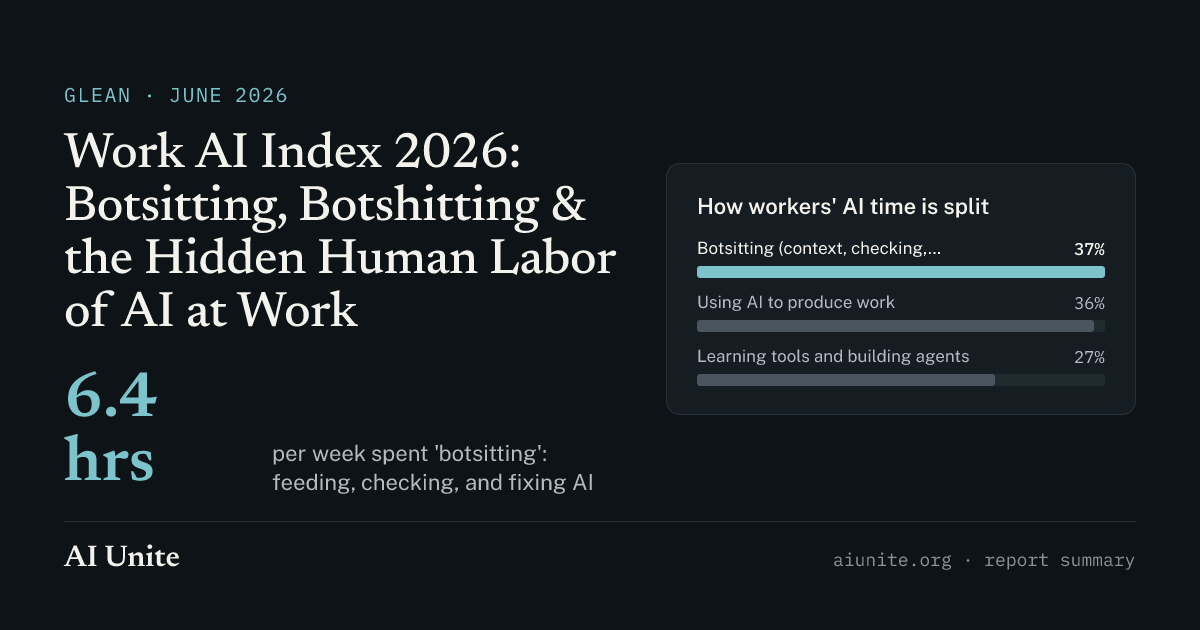 Work AI Index 2026: Botsitting, Botshitting & the Hidden Human Labor of AI at WorkWorkers report 11 hours a week saved but 6.4 hours spent supervising and fixing AI; only 13% see significant organizational gains.
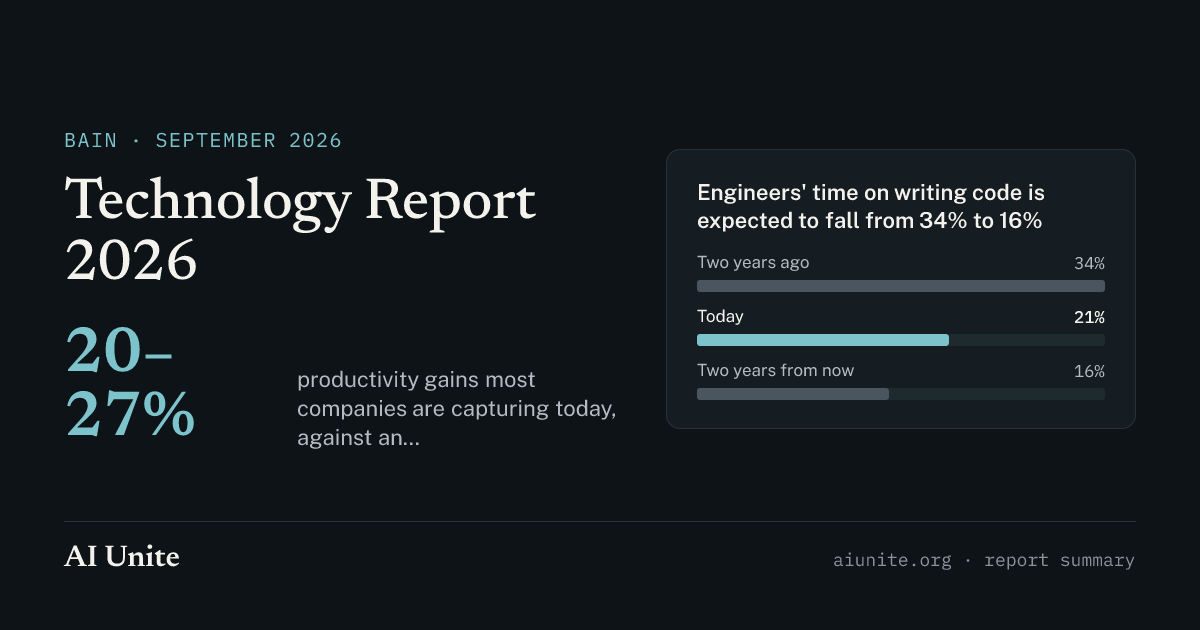 Technology Report 2026Leaders expect a 95% developer productivity uplift in 1–2 years; current gains are 20–27%. Bain says AI moves bottlenecks into review and coordination.