Canaries in the Coal Mine? Six Facts about the Recent Employment Effects of Artificial Intelligence
Stanford Digital Economy Lab's Canaries in the Coal Mine? (August 2026 update; ADP payroll data on 3.5–5 million workers a month, labor data) found that employment of 22–25-year-olds in the most AI-exposed occupations stands 19% below where it would be had it kept pace with less-exposed peers, while overall employment shows no widespread displacement.
Key findings
- 01Employment of workers aged 22–25 in AI-exposed occupations is 19% below where it would be had it kept pace with less-exposed peers.Experienced workers in the same occupations show no comparable gap. The authors call these descriptive indicators, not causal estimates. (p. 1)
- 02The gap has widened from 15% at the July 2025 data vintage to 19% as of June 2026.Earlier versions of the paper (August 2025) headlined a 13% regression-adjusted relative decline; this update emphasizes the simpler descriptive divergence. (pp. 2–3)
- 03In levels, employment of 22–25-year-olds in the two most exposed quintiles fell about 11% from November 2022 to June 2026, while the same age group in the three least-exposed quintiles grew about 10%.The shortfall operates mainly through reduced hiring of young workers rather than more separations. (p. 3)
- 04Across the whole ADP sample, employment rose about 6% from November 2022 to June 2026, and about 4% in the most exposed quintile.The authors find no evidence of economy-wide job displacement from AI. (p. 10)
- 05Declines concentrate in occupations where AI usage mainly substitutes for human tasks; where it mainly complements workers, employment is flat or rising.Adjustment is showing up in headcount rather than in base pay. (p. 1)
By the numbers
19%employment shortfall for 22–25-year-olds in AI-exposed jobs (June 2026)
−11%change in employment of 22–25-year-olds in the two most exposed quintiles, Nov 2022–Jun 2026
+6%change in overall employment in the ADP sample over the same period
What it means for you Draft
For executives at $10–100M companies
This is the clearest large-scale evidence so far that AI is changing who gets hired, not how many people are employed overall. For a $10–100M company, the practical question may be how you will grow senior talent in five years if you hire fewer juniors now. It is descriptive evidence, so it does not tell you AI caused the change.
For practitioners
If your team has quietly stopped backfilling entry-level roles in AI-exposed functions, you are consistent with this pattern; decide whether that is a plan or a drift. Track junior hiring and training paths explicitly rather than assuming they will recover on their own.
Limitations
High trust.Large administrative payroll panel, extensive robustness checks and disclosed caveats; academic authors, publisher does not sell AI.
ADP clients may not represent all US firms, and the divergence is larger in ADP data than in national surveys. Some divergent trends predate ChatGPT and results attenuate when controlling for education. The authors stress these are descriptive, not causal.
Stanford Digital Economy Lab. "Canaries in the Coal Mine? Six Facts about the Recent Employment Effects of Artificial Intelligence." August 2026. https://digitaleconomy.stanford.edu/publication/canaries-in-the-coal-mine-six-facts-about-the-recent-employment-effects-of-artificial-intelligence/
Related reports
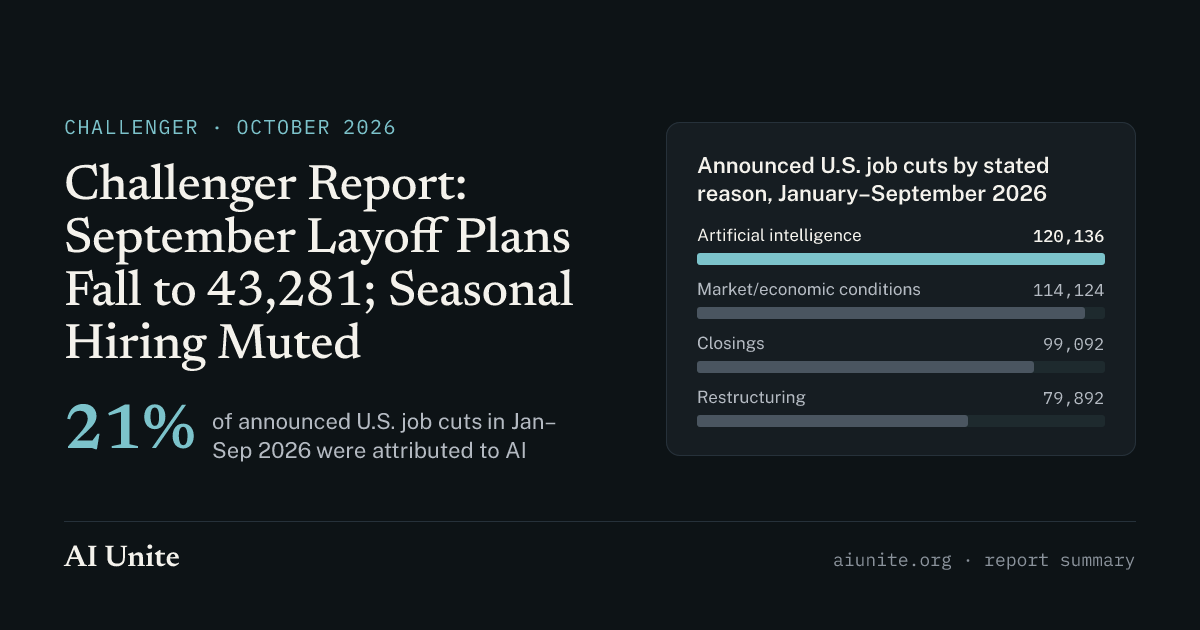 Challenger Report: September Layoff Plans Fall to 43,281; Seasonal Hiring MutedAI remains the most-cited reason for announced U.S. layoffs in 2026, though September cuts tied to AI were 3,961, about 9% of the month's total.
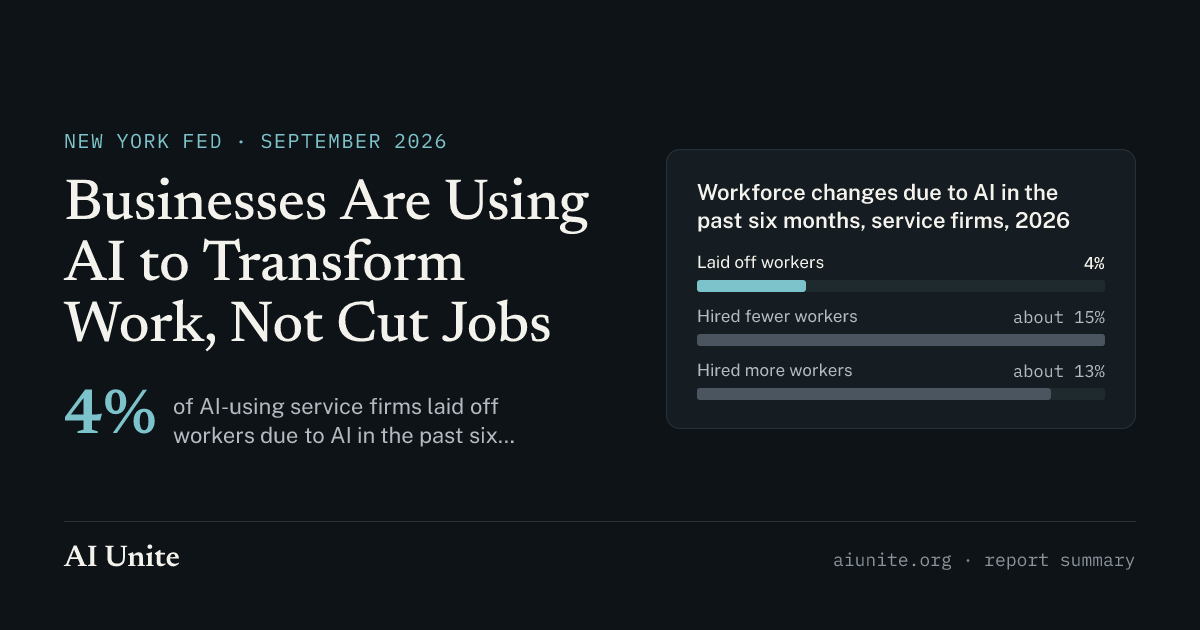 Businesses Are Using AI to Transform Work, Not Cut JobsAI use among regional firms jumped again in 2026, but layoffs stayed rare; retraining remains the main workforce response.
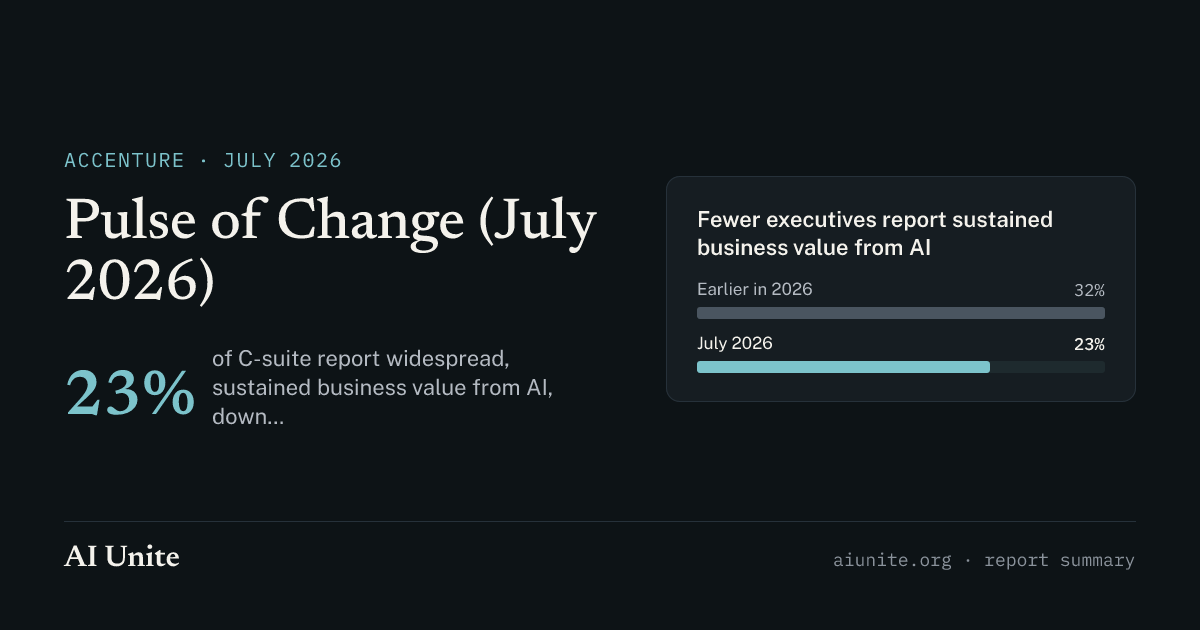 Pulse of Change (July 2026)82% of C-suite leaders are increasing AI investment; 49% of companies are piloting or deploying AI agents.